What Holds the Bridge
Andrew Shaughnessy
Creation occurs everyday by both human hands and nonhuman forms. These acts bear a generative beauty akin to artistic practice: rendering the possibilities of what could be from the reality of what exists. The first biblical account of creation describes a God in the act of making, one who speaks order into a swirl of chaos. The second account offers meaning to human creation: till and keep the world in which we inhabit. This intention to participate in the care of one’s home—to partner with Creator in naming evil and calling forth tenderness—reverberates throughout the prophetic imaginations of ordinary people cited in the biblical narrative. And it continues today, as I recently witnessed, through the calloused hands of farmers residing at the margins of our world.
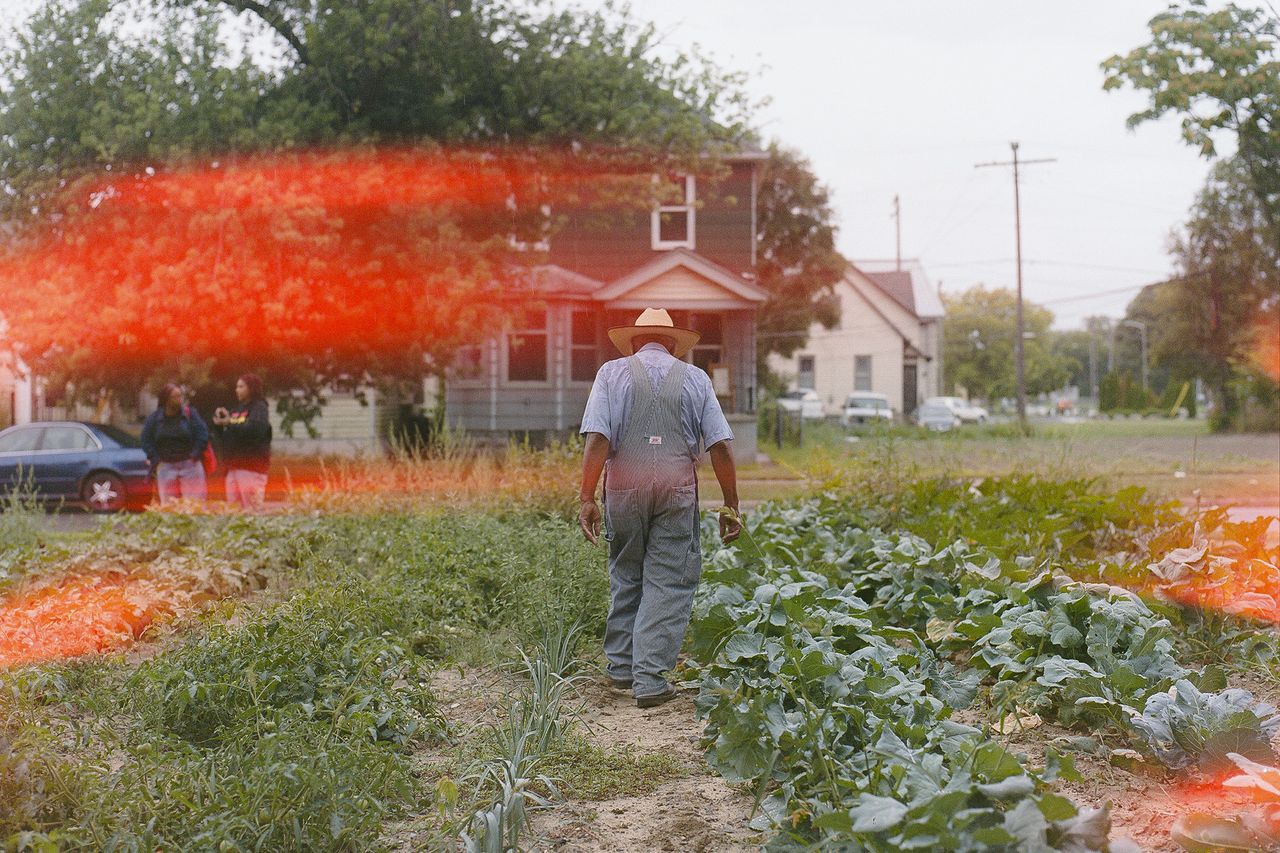
On an overcast August day in Detroit, Michigan, Willie Patmon walks rows of sprouting collard greens. My eyes flit between them, enamored with their broad, dusty leaves as I move to keep pace with him. Our walk is a delicate act of scanning the earth. Mr. Willie shares that he has recently planted onion seeds and we are careful not to step on them as we follow his lead. Once settled beneath a peach tree, he hands me a small orb of fruit—the sweetest I have tasted in a while. The exchange brings me joy and Mr. Willie throws a knowing grin, one full of wisdom, warmth, and defiance.
At 91 years old, Mr. Willie has spent much of his life tending land in the midwest. As a fourth generation farmer from Crescent, Oklahoma, he takes pride in that lived experience, founding the non-profit WJP Urban Farms to share all he has learned with the next generation. Working with a local mutual aid fund—Detroit Black Farmer Land Fund—he has purchased 14 plots of land in his neighborhood totaling just under an acre. Each plot is the size of a modest backyard, holding a host of organic crops that feed the neighborhood.
Considering the history of Black farmers in the United States, WJP Urban Farms is a stunning vision. The lots that Mr. Willie owns were formerly abandoned and appeared untenable to the untrained eye: the soil riddled with rocks and debris from contractors using the space as a trash dump. But like many residents throughout Detroit, a city once saddled with years of economic decline, he saw in those lots an opportunity to support the revitalization of his community. And having grown up making the best of land that others considered to be the worst (“bottom” or “scrub” land in Oklahoma), he is no stranger to the resourcefulness required of those who exist on the edges of dominant culture.
Partnering with campuses in his local school system, Mr. Willie invites students to his plots to learn the creative acts of planting and harvesting. When I ask what their reaction is to picking their own food, he mentions that they are excited, finding it hard to believe that they nurtured these fruits and vegetables to a full life. I imagine that in the process the youth gain an intimate lesson in an ancient practice continued by Black farmers: the resilient art of coaxing goodness from the chaos of a shared world.
Willie Patmon’s story and spirit recalls another farmer, one whose life is briefly chronicled in the book of Genesis.
The biblical patriarch, Isaac, begins his journey by planting grain within a famine. The idea is ludicrous: sow seed in a land that is not your home, that is not fertile, when there are no resources. And yet, he scatters seed generously and waits to see what comes. Isaac likely anticipated a modest crop that could sustain him and his family. What came was a hundredfold harvest; a full and complete return that reveals the briefest glimpse of flourishing. The harvest is an allegory for planting when there is no evidence that anything will come of that work. As a foreigner in the land, Isaac commits to what cannot be seen or known in full. He places seed in the ground and leaves the outcome to the Creator, dependent upon the soil, sunlight, rain, and time to yield what is needed. Isaac models creaturely participation: an active trust in all of creation to work in harmony, as all that is made is called forth by the same breath. Similarly, farmers living in the margins bear witness to a vision of a world that is not yet here.
The present world is coming to an end. At least, that is what can be surmised from media attention and casual conversations around climate change and ecological decline. Headlines promise impending doom with each scroll, often lulling readers into concurrent shock, fear, apathy, and overwhelm. There is an underlying grief that accompanies these emotions, often manifesting in the terror of apocalypse. That language envisions a final destruction to the earth, with the promise of perfection to follow in another place.
Theologian Catherine Keller suggests that there is a better way to read the book of Revelation, a letter written by the apostle John that is often quoted to affirm an outlook of the end times. In the original Greek, apokalypsis is an unveiling, a definition that allows Keller to propose her framework of “dreamreading” the well-known text. The true nature of apocalypse rejects certainty steeped in fear, preferring a revelation of societal patterns ripe for new creation. Keller’s dreamreading of Revelation creates space for the work of possibility. Apocalypse as a type of disclosure means a future that is not yet here can be shaped. Better still, it must be shaped. Keller finds precedence for this reading through the work of resistance. “Turns out that all of Western egalitarian or revolutionary movements, the fights for democracy, socialism, women’s rights, emancipation of slaves, right on through Martin Luther King’s ‘dream,’ tapped apocalyptic metaphors of great tribulation and transformation,” she writes. “In their struggle for a ‘new heaven and earth,’ for a just and sustainable life for all, they draw from the ancient Jewish prophetic tradition of the ‘new creation.’”
So, yes, the world as we know it may end. But this is not the first time that the world has ended. At least not for those subject to systems enacted against them. For Black farmers, that has included facing racism brought on by exploitative labor, discriminatory practices, and economic greed. Still, it has not stopped their living into the “new creation.” That fact is personal for Mr. Willie, whose farming lineage traces back to chattel slavery. His great-grandfather and grandfather owned land in Georgia and Oklahoma, respectively. Mr. Willie’s own 14 plots of land in an urban setting built upon his family history of planting toward a future that is believed before it is brought to fruition. There is hope in the apocalypse—the vision for a new world that is fully whole and alive rests with those who identify in the shadows of the present one. The future will break forth not elsewhere, but here.
While apocalypse as unveiling is much more expansive than final destruction, it is no less consequential. “The life of a farmer… helps anyone to live a better life because the disciplines of a farmer will work on anything,” shares Mr. Willie. “Farmers are very serious about that discipline, because it’s either that or you don’t exist.” For those dependent upon the harvest for survival, the act of creation is vital. The stakes are just as high in our daily living and they should be, if we believe in the next chance. The kind of discipline Mr. Willie mentions applies to more than agricultural crops. This is learning to till and keep the earth (our physical place) and the world (what mindsets guide our daily existence.)
In the poem “To See the Earth Before the End of the World,” Ed Roberson makes a similar distinction between the two entities. He writes that people are grasping at the chance to consume what they want before the world ends. Aware of change looming on the horizon, he surmises that we continue to live our days in a pattern of not seeing or really caring for what is happening. When faced with grief over a world that does not appear to have much time left, we seek individual security and comfort over the well-being of the wider world. Why be attuned to suffering, care for our present home, or seek the fullness of communal joy when it is all slated for collapse?
Our shared future is not decided just yet; another option is possible. The truth is that a wider world built on domination, oppression, and greed should end. But it should be done so with an eye toward earthly transformation. The resilience needed to coax goodness from chaos requires the discipline of seeing and living toward “new creation” here on earth. In the face of every impossibility, farmers like Mr. Willie exercise trust in the unknown darkness of rich soil to participate in an act of creation that is both redemptive and generative. It is a cycle rooted in the belief that there is something that can be molded even now—that all of creation plays a part in tending and keeping. May the Isaacs and Mr. Willies in our spheres lead us to lay down declarations of final destruction in favor of shaping what we can, dependent upon the breath of Creator.

أفيري ماركس
محرر الميزات